Why Did My Car Insurance Go Up Even Though I Haven’t Had an Accident?
If your car insurance rate went up even though you haven’t had an accident, filed a claim, or gotten a ticket, you’re not alone. This is one of the most common questions drivers ask, especially as auto insurance rates continue to rise across Arizona.
From your perspective, nothing may have changed at all. You could have the same vehicle, same address, same coverage, and a completely clean driving record, yet your renewal still comes back higher.
The reason is that insurance companies do not price your policy based only on your individual history. Your personal record matters, but your rate is also tied to the larger group of drivers you are being insured alongside and what it is costing the insurance company to cover that group.
Why Car Insurance Rates Can Increase Without an Accident
Insurance companies look at much more than whether you personally had a claim. Your driving history, age, vehicle, location, coverage limits, and other individual factors all matter, but insurance pricing also depends heavily on the claims experience of larger groups of similar drivers.
If those drivers start having more accidents, more expensive claims, or higher repair costs, the overall cost of insuring that group increases.
That means your car insurance premium can go up even when you personally did everything right. A clean driving record may help keep your rate lower than someone with accidents or tickets, but it does not completely separate you from broader insurance rate increases.
What Is the Law of Large Numbers in Insurance?
The law of large numbers is one of the basic ideas that makes insurance work, and it is much simpler than it sounds.
An insurance company cannot predict whether you personally are going to have an accident next year, but it can look at thousands or millions of similar drivers and make a fairly accurate estimate of how many accidents that entire group will have and how much those claims will cost.
The larger the group, the easier it becomes to predict the overall results.
Insurance companies use that information to determine how much premium needs to be collected to pay expected claims, which is why your individual driving history is only one part of the picture.
What Do Other Drivers Have to Do With My Insurance Rate?
More than most people realize.
Imagine an insurance company covers 100,000 drivers. Some will never have an accident, some will have minor accidents, and a smaller number will have very expensive claims.
The insurance company looks at the total results of that group and uses those numbers to predict what the next year may look like.
One new driver or one accident is not going to suddenly change everyone’s rate, but when thousands of drivers begin having more accidents or those accidents become more expensive, the cost of insuring the group changes.
That is when rates can start moving, even for drivers who personally have not had a claim.
Why Are Car Insurance Rates Going Up in Arizona?
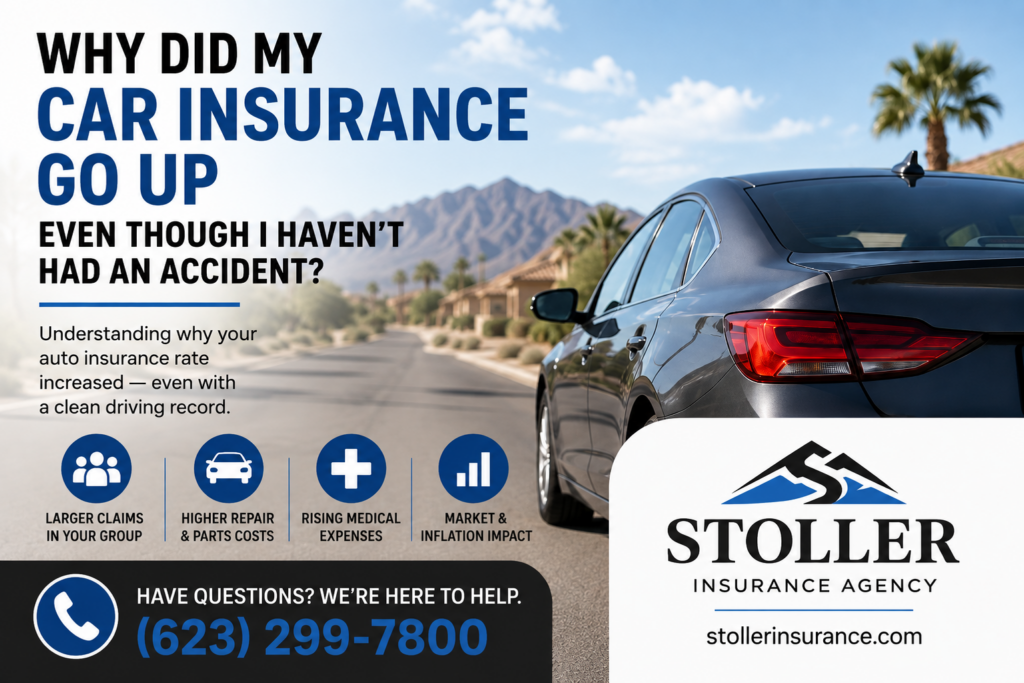
One of the biggest reasons car insurance rates are going up in Arizona is that claims are becoming more expensive.
Modern vehicles are packed with cameras, sensors, computers, radar systems, and other technology that can make even a relatively minor accident costly to repair. A bumper is not always just a bumper anymore. Replacing one may also involve sensors, cameras, wiring, calibration, and additional labor.
Medical costs, replacement parts, towing, rental vehicles, and total loss values can also increase the cost of a claim.
When the average claim costs more, insurance companies eventually have to adjust rates to account for that increase.
Does a Clean Driving Record Still Help My Insurance Rate?
Absolutely. A clean driving record still matters and can have a significant impact on your car insurance premium.
Someone with multiple accidents or tickets will usually pay more than a similar driver with no violations or claims.
Your individual history helps determine where you fall within the larger insurance group, but it does not make you immune from changes affecting that entire group.
In other words, being a safe driver is still helping you, even if your rate went up. You may simply be paying less than you otherwise would if your record was worse.
Can I Lower My Car Insurance Rate After an Increase?
Sometimes.
A rate increase does not automatically mean you should switch insurance companies, but it is a good reason to review your policy and make sure everything still makes sense.
You can look at your deductibles, available discounts, vehicle usage, coverage limits, and whether bundling your home and auto is actually helping.
In some cases, another insurance company may simply have a better rate for your specific situation.
This is where working with an independent insurance agency can be helpful because different companies can look at the exact same driver very differently.
The Bottom Line
Your car insurance rate is based partly on you, but it is also based on what is happening throughout the larger insurance market.
A clean driving record still matters, and having no accidents or tickets can absolutely help keep your premium lower. But insurance works by spreading risk across large groups of people, which means the claims experience of other drivers can affect what you pay.
If accidents become more expensive or more frequent within your insurance group, rates may increase even when you personally have not done anything wrong.
So if you are wondering why your car insurance went up even though you haven’t had an accident, the answer may simply be that the cost of insuring the larger group changed, even though you didn’t.


